
Minerva: Gathering Feedback to Drive Continuous Improvement
- Tags
- News for Staff
In this article:
Our Approaches to Feedback
Student Feedback on Minerva Module Areas
Minerva Module Template and Required Elements
The Digital Education Service (DES) regularly collects feedback from staff and students to ensure our digital systems remain innovative, fit for purpose and foster an outstanding student experience while helping learners achieve their full potential.
Our Approaches to Feedback
We gather feedback from our stakeholders in a variety of ways, including focus groups, workshops, in-depth discussions with small participant groups, and surveys (including the NSS and JISC Digital Insights).
Our annual Minerva surveys, which take place each year in November/December for students and December/January for staff, provide an opportunity for us to assess changes we've incorporated within Minerva ahead of the next academic year to ensure the best possible learning experience for our students and to further reduce administrative tasks for staff.
These approaches provide valuable insights that we use to lobby our suppliers for improvements to our digital learning systems, identify gaps in provision and inform our practice. You can find more information on how we incorporated feedback into our processes in the article below.
Look out for our forthcoming Minerva survey
We'll be running our staff and student Minerva surveys within the next couple of months, so make sure you check back to this website to find out how you can feed back to our team.
Student Feedback on Minerva Module Areas
Consistency in Module Areas
Our students’ need for consistency in the design and structure of their Minerva module areas has been a key theme in feedback gathered over recent years. Many students were frustrated over the lack of key content in some modules (eg contact details and details about how individual pieces of assessment contribute to their final module mark) and raised concerns about inconsistent module structures, even within the same programme of study. They felt this lack of consistency created unnecessary strain, making their learning experience more difficult than it needed to be.
Minerva usage varies according to module leaders. The structure is always different in modules. I sometimes get lost when looking for class materials
Anonymous student
To gain a greater understanding of student feeling about this issue, specific questions about module areas were added to last year's Minerva student survey, which ran at the end of Semester 1.
Students were asked if they would “like all Minerva module areas to be designed and structured the same way”, with 88% of respondents strongly agreeing or agreeing, while 10% neither agreed nor disagreed.
I think the structure of module areas could be improved because sometimes the information I need isn’t under the right sections and it’s mixed up, confusing and takes a lot longer to find what I need
Anonymous student
A series of qualitative sessions with Student Ambassadors, recruited by DES to represent student voices, reinforced this desire for consistency. Several Ambassadors shared personal accounts of the problems they’d experienced when studying modules which were structured differently, particularly with assessment submission and difficulties finding key information, such as staff contact details.
Using guidelines for minimum requirements
We also consulted with peers at 14 universities throughout the UK to understand how widespread this desire for consistency was amongst students at other institutions. Each university we spoke to had received similar feedback from their students in the past and the majority had developed guidelines setting out minimum requirements for content within module areas along with some degree of standard structure. Where guidelines had been implemented, positive reports were received from both students and staff.
Further qualitative feedback sessions with Student Ambassadors and key academic stakeholders were undertaken at Leeds to understand how the delivery of guidelines for Minerva modules areas might be received, with both groups responding positively.
Staff raised concerns about increased workload, but felt that the development of clear guidance, setting out what is expected from Minerva modules, may help reduce their administrative tasks.

The Digital Education Service regularly runs workshops with staff and students to understand their experiences of using our digital systems.
Minerva Module Template and Required Elements
In the autumn of 2023, we constituted a working group to explore how improved consistency might be delivered in Minerva module areas, drawing on the experiences of peer institutions.
Working with our stakeholders
The working group consulted widely within the University and ultimately prioritised key areas, such as assessment, accessibility and contact details, as well as looking for opportunities to make the creation and maintenance of Minerva module areas easier for staff. Amendments to the institutional module template were suggested as a result, along with a list of required template items that should be used in all modules.
We worked with colleagues from across the institution to ensure that core items within the institutional module template were populated with text where possible, to reduce the need for staff to create from scratch. An example of this is the revised Accessibility Statement.
Using the Accessibility Statement Template
An analysis of module areas from the previous academic year showed only around a quarter had an accessibility statement, with staff telling us this was often because they weren’t sure what to include.
As a result, we included a statement in the template for 2024/25 modules, which was written in collaboration with University experts in inclusive learning and teaching practice. This clearly sets out Leeds’ position regarding the accessibility of teaching content, informs students what to do if they notice any concerns with content and provides an opportunity for staff to record any accessibility issues they are aware of.
By pre-populating text in the accessibility statement, we were able to ensure that students are presented with important accessibility information in all their modules. Staff workload was also reduced by taking away the need to create a new statement for each module.
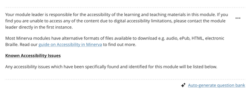
The new default Accessibility Statement text, deployed within all 2024/25 modules
Developing guidelines
We subsequently developed guidelines setting out which of the template items were required to be used and rewrote guidance to provide staff with greater clarity over how they should use the template to provide a more consistent module structure for their students.
Drafts of the institutional module template and guidelines and guidance for use were shared with Student Ambassadors and staff and updated in response to feedback, before their launch in summer 2024.
Our ‘Using the Minerva module template and top tips for building modules’ web page was promoted widely to staff and is linked directly from each module area (students cannot see this link). Teams within DES also worked together to ensure appropriate and timely training was available to staff within faculties over the summer period in 2024.
Remember to look out for our forthcoming Minerva survey
Our annual surveys provide an opportunity for staff and students to let us know about their experiences of using Minerva so that we can work to continuously improve this learning system. We'll be running the surveys within the next couple of months, so make sure you check back to this website to find out how you can feed back to our team.