
Getting Started with Minerva - Student Guides
Minerva is your Virtual Learning Environment (VLE) and portal to other key University systems. This is where you will access resources related to the modules you are studying, view organisations (e.g. your faculty, school or programme of study page), discuss concepts and ideas with peers, submit your assignments, find important links and more.
Watch the 6 minute video below for an overview of Minerva. On this page you can also read about the different ways you will use Minerva.
Accessing Minerva: login
- Visit minerva.leeds.ac.uk and sign in using your University credentials ([email protected] and password)
- You will land on the My Leeds homepage, featuring personalised content and useful links.
- Visit the browser checker on Blackboard's website to check if your browser supports Minerva.
If you are having issues accessing Minerva, please see the What to do if you can't access Minerva guide. (This link takes you to the University of Leeds student website). Or, if you are having issues with setting up Duo two-factor authentication, please see the Enrolling for Duo two-factor authentication guide (This link will take you to the IT support website).
Related Guides
IT at the University of Leeds – Essential Guide for New Students (This link will take you to the IT support website).
Navigating Minerva: Finding your way around
The Global Navigation Menu on the left-hand side gives you access to different parts of Minerva.
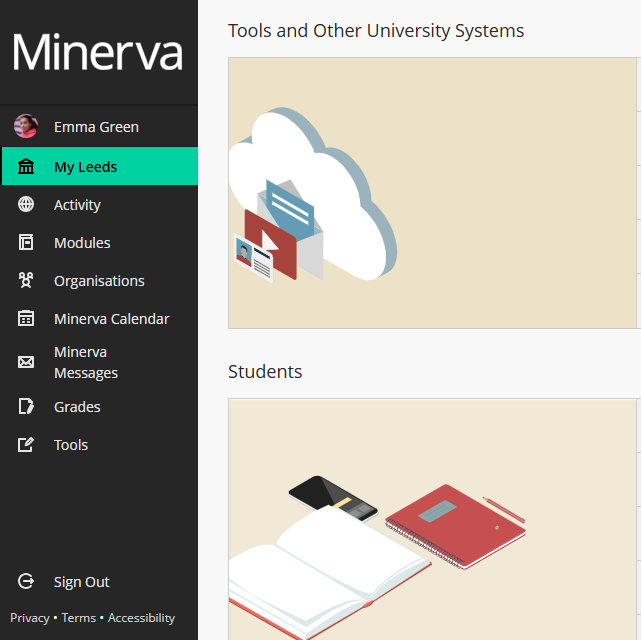
The different parts of Minerva are:
- Profile - Select your name to access the profile page. Here you can add a profile picture, visible to staff and your fellow students in Minerva, and add a pronunciation of your name.
- My Leeds - This is the home page for Minerva and contains links to University systems, services and information. Portal widgets and help links are broken down into sections, and each section is targeted at broad audiences so that you see the information most relevant to you. Where a topic has more than 5 links, the list can be expanded to show a larger selection of resources to the right (by selecting the Show All link).
- Activity - Recent updates across all modules and organisations display here, including announcements, new content, and Minerva assessment deadlines (although if your School uses Gradescope, you will not see deadlines here.) Update your notification settings and email preferences from the notification settings page. For Discussions, we recommend using the separate follow discussions function, to receive email notifications on a discussion-by-discussion basis.
- Modules - This is where you access your Minerva module spaces. There are options for different views/filters and ways to search for your modules. You can view by list or grid, filter by year and choose which academic year (term) to see. By default, modules for the current year will display at the top. You can search for specific modules, and mark favourites which will then always appear at the top.

- Organisations - Here you'll find learning and teaching spaces that aren’t part of a module (e.g. your faculty, school or programme of study page). You can search for organisations and mark them as favourites. They cannot be refined by year.
- Minerva Calendar - Here you will see Minerva module events (e.g. Minerva assessment deadlines – Gradescope assessments don't appear here so it is recommended that you check your modules for a comprehensive list of deadlines). This is separate from your official timetable (MyTimetable).
- Minerva Messages - These are direct messages from module staff to individuals or groups (separate from announcements). If you have new ones to read, this is highlighted by a number in the messages icon:
- Grades - View grades and feedback for all your modules. Use the previous and next term buttons (arrow icons) at the top of the page to view grades by academic year. Note: Exam results are not shown here. Minerva grades and percentages may only be indicative of performance, and may not represent a final grade.
- Tools - Access tools like module evaluations when available.
- Sign Out - Use to securely log out of Minerva. To fully log out you will need to select 'End SSO Session' on the next page. This is an important step if you are using a shared computer.
Related Guides
Can't find/see a module? Find or search for a module you are enrolled on, in Minerva
Navigating Modules and Organisations
Selecting either Modules or Organisations will take you to a list of the ones you are enrolled on, where you can then select the one you want to open. In this guide we will focus on Modules but you will find the tools/menus and layout similar for Organisations.
Navigation Bar

The Navigation bar in your module area contains tabs to key tools. Alerts (a number in a circle) highlight when there is something new to review for Announcements, Discussions, Gradebook or Messages.
The different part of your module are:
- Content – This is where you will find information about the module and staff, learning resources and assessment information. Make sure you take time to see what content is available. More is usually added as the module progresses. If you are looking for something in particular, you can search for items by title on the Module Content page. Select the Search module content button (or magnifying glass icon) located at the top right of the page, enter your search term, and select the item from the list to access the content. For full instructions, see the Course Content Title Search guide. (This link takes to you to the Blackboard help website)

- Calendar – Shows only events set within that specific module. More about calendar.
- Announcements – Displays tutor updates. You’ll see a pop-up for new announcements when you first open a module; dismissed ones are accessible here.
- Discussions – Tutor-led or student-enabled forums (if used). More about Discussions.
- Gradebook – View your grades and feedback for that specific module.
- Messages – Read module-specific messages (used at the tutor’s discretion).
- Groups – If used, shows groups for projects or collaboration.
Details & Actions Panel
This is to the right of the module content.
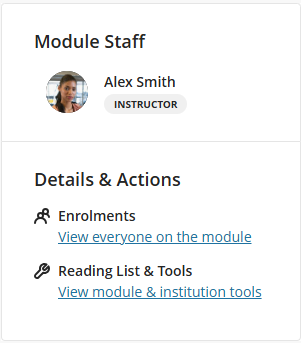
Here you will see:
- Module staff - The module leader is usually displayed.
- Enrolments – View the student list (if visible in your module).
- Reading List & Tools – View the module reading list and other resources.
Module switcher
Located above the Module Navigation Bar, select the ‘Modules’ button to access the module switcher drop-down menu.

You can use the drop-down to move quickly between your four most recent modules, or use search to access any module. The Favourites tab shows any modules you have marked as favourite on the Modules page. You can also select ‘View All’ to return to the Modules list page.
Module Content
Your modules should have a similar structure. You can expect to find:
- Submit my work - Assignment submission points. For further information about this section, please see the Submissions, Feedback and Grades section below.
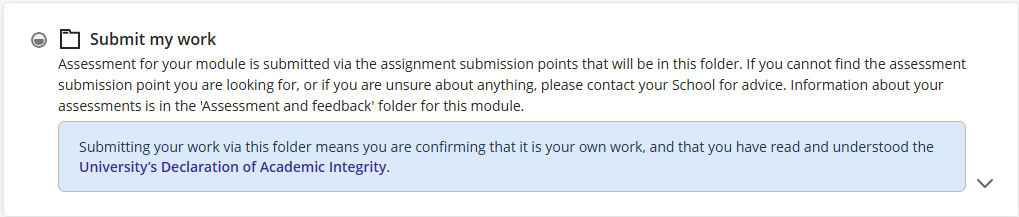
- Module Information & Help – Orientation and guidance materials.

- Reading List & Lecture Capture – Essential reading and recorded content.

- Assessment & Feedback – Assessment information. For further information about this section, please see the Submissions, Feedback and Grades section below.

- Weekly/unit-based structure - You should see a consistent week or unit-based structure where you can find key learning resources, such as lecture slides.
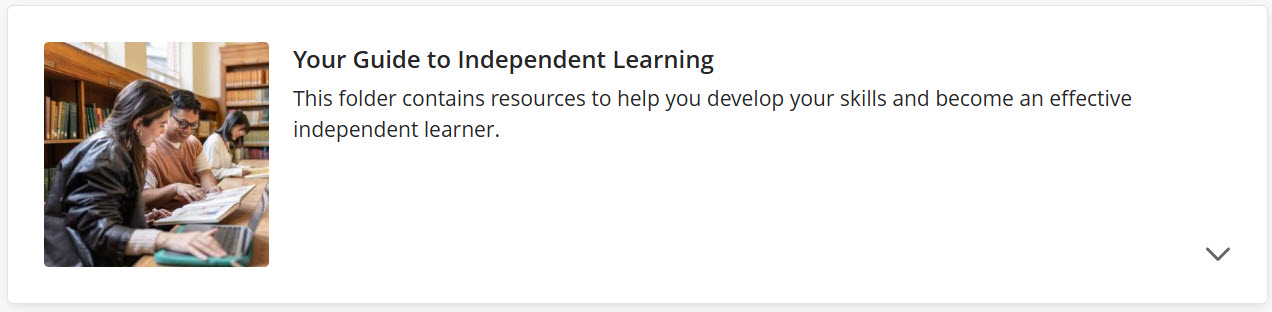
- Your Guide to Independent Learning – Tips and resources for academic success.
Making content work for you
To help you stay organised and get the most out of your modules, Minerva includes features that let you navigate, search, track your progress, and access content in different ways:
- Expand/collapse folders and use the table of contents to navigate through learning materials.

- Use search module by content (top right of content area) to locate items by title.
- Use Progress Tracking (if enabled) to monitor your engagement. Content that requires participation or submissions, like Assessments, Tests, Journals or Discussions, will automatically be marked as complete (with a check mark) once you have submitted your work. For other content, such as links and uploaded files, you can manually mark them as complete once you have opened them. More about Progress Tracking.

- You might see the option to Download alternative formats of content in your modules and organisations e.g. audio, ePub, HTML, electronic Braille. For example, if your lecturer has uploaded a Word doc, but you prefer audio, you’ll have the option to download it in that format. Select the Download alternatives formats button (this looks like a capital ‘A’ ) next to files in Minerva. More information about alternative formats and Ally
Related Guides
Submissions, Feedback and Grades
Submit work
Go to your module and navigate to the Submit my work folder, which can normally be found at the top of the module content page.
Receive Feedback and Grades
Typically, you can see grades and feedback by accessing the Gradebook link in your module. You will see an alert next to the link when there are marks/feedback to review. You can also use the Grades option from the Global Navigation menu to get to the Gradebook for your module.
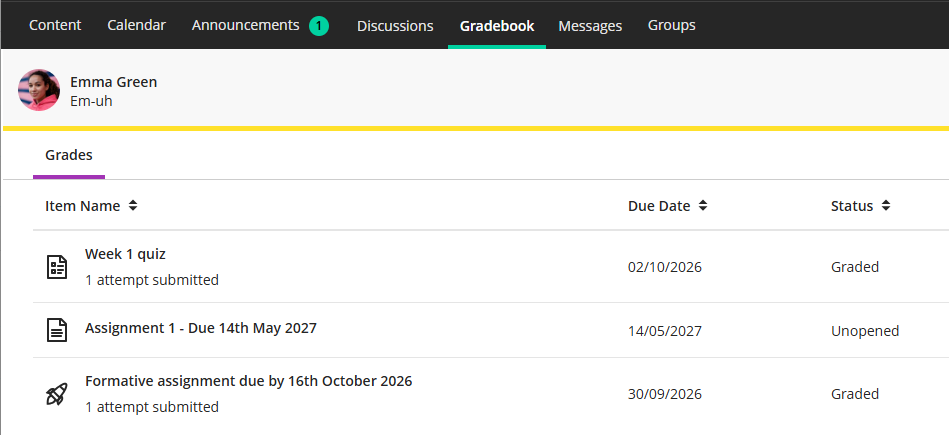
Please note: Exam results are not shown in Minerva. Grades and percentages shown in Minerva may not reflect your final module result.
Related Guides
Need further help with Minerva?
Browse our A to Z of Minerva Guides which lists all the Minerva guides currently available on this site. Guides useful for students new to Minerva include:
Set up
- Change/personalise your Minerva notification settings
- Add how to pronounce your name
- Change your Minerva profile picture
Modules and Organisations
- Find or search for a module you are enrolled on, in Minerva
- What are Minerva Organisations?
- Progress tracking in Minerva - understand what content you've already opened
- Searching a module for content? See the Course Content Title Search guide. (This link takes to you to the Blackboard help website)
Assessments
If you have a technical problem, please contact IT Services (log in to see options to report something broken).